
32 Days / 31 Nights
Madagascar Azur
Price
1Pax€ 8070
Antsirabe, often called “Ville d’eau” (“City of Water” in French), is the third-largest city in Madagascar and the capital of the Vakinankaratra region. As of 2024, it has a population of about 265,000 people. The city is well known for its cool climate, typical of Madagascar’s central highlands, its industrial activity, and its iconic pousse-pousses (pulled rickshaws), which are a common sight in the streets.
Antsirabe attracts around 30,000 tourists each year, drawn by its thermal springs, relaxed atmosphere, and local culture. It is also home to a major beer production facility, making it an interesting stop for visitors who enjoy sampling locally brewed drinks.
Upon arrival in Miandrivazo, the adventure begins the following morning with a drive along a good paved and secondary road to the village of Masiakapy, where river navigation starts. Here, you board a traditional local boat or motor boat.
The majestic Tsiribihina River flows between the foothills of the Highlands before entering the dramatic vertical cliffs of the Bemaraha Canyons, where lush tropical forest thrives and lemurs inhabit the trees.
During several stops along the way, you venture inland to discover spectacular waterfalls and natural pools hidden within dense, luxuriant vegetation.
Further downstream, the landscape opens into wide savannah dotted with baobabs, interspersed with mango and tamarind forests, as well as the farms and villages of the Sakalava people.
Throughout the 2.5-day river journey, you may observe a rich variety of wildlife, including parrots, ducks, herons, act….. With a bit of luck, crocodiles and turtles can be seen basking on the rocks, while lemurs move through the trees.
At night, you camp along the riverbanks in igloo-style tents equipped with mosquito netting. Meals are served either on board or ashore, depending on the group size and conditions.
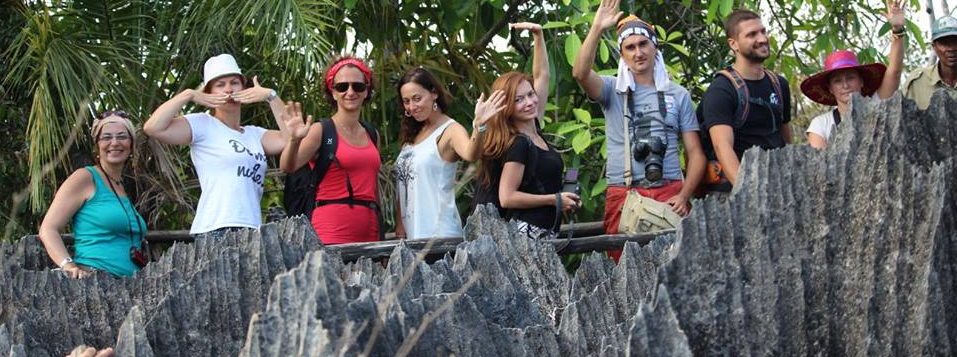
Tsingy de Bemaraha is a remarkable geological formation located in the central-western part of Madagascar. It forms part of the Parc National Tsingy de Bemaraha, which is internationally recognized for its dramatic karst landscapes, featuring sharp limestone pinnacles, deep canyons, forests, and underground caves.
The park hosts exceptional biodiversity, including 11 species of lemurs, over 100 species of birds, and dozens of endemic amphibians and reptiles. The “tsingy” formations, jagged limestone structures shaped by millions of years of erosion, create a striking landscape often compared to a natural stone cathedral.
Designated as a UNESCO World Heritage Site, the park stands out for both its natural beauty and its ecological importance, making it one of Madagascar’s most extraordinary destinations.
Kirindy Forest, located about 70 km from Morondava, is one of the natural treasures of western Madagascar. This protected forest is renowned for its rich biodiversity, hosting around eight species of lemurs, 68 species of birds, and more than 40 types of reptiles.
Kirindy is also famous for its unique wildlife, including endemic carnivores such as the Fossa and the Narrow-striped mongoose. The forest is dotted with iconic baobab trees and offers varied landscapes that make it ideal for wildlife observation.
Visitors can encounter both diurnal and nocturnal species, such as the Malagasy giant jumping rat, Verreaux’s sifaka, Pale fork-marked lemur, Gray mouse lemur, and the tiny Madame Berthe’s mouse lemur : the smallest primate in the world.
This tour is characterized by visits to the national heritage. The Baobabs is one of the most beautiful sites of the Big Island. This place, not far from Morondava, is unavoidable during a trip to the center-west of Madagascar. In this site, you will be astonished to see these trees of more than 30 meters in height bordering the track leading to the banks of the Tsiribihina river on more than 20 km.
At sunset, the colors behind these giant trees offer an exceptional spectacle. A sacred baobab tree stands out among those lining the track. The locals come here to deposit offerings and honor their ancestors. According to legends, the Gods did not appreciate the baobabs’ excessive pride, so they decided to plant them upside down, putting the roots in the air. You will also see baobabs said to be in love, which according to the beliefs of the locals can bring good luck to couples. On the premises, the most striking species is the Andasonia grandidieri. Of course, this tree is endemic to Madagascar.
The coastal trail from Morondava to Ifaty is a scenic journey through the southwest of Madagascar, offering a rich blend of coastal landscapes and cultural experiences.
The route begins in Morondava, where visitors can discover the way of life of the Vezo people, renowned for their traditional fishing techniques and deep connection to the sea. It then passes through Belo-sur-Mer, a peaceful destination known for its fishing villages and beautiful, unspoiled beaches.
Further along, the trail leads to Andavadoaka and Ambatomilo: two of the most picturesque locations in the region. These villages are characterized by their turquoise waters, white sandy beaches, and relaxed atmosphere. Visitors can enjoy snorkeling, beach activities, and opportunities to observe local marine and coastal wildlife.
Overall, this coastal trail provides a unique and immersive way to experience the natural beauty and cultural richness of Madagascar’s southwest coast.
The Reniala Forest is home to an extraordinary concentration of baobabs, with seven of the eight species found worldwide being endemic to Madagascar. These remarkable trees are known for their unusual and varied shapes, even within the same species. Throughout the forest, baobabs take on striking forms, resembling conjoined twins, embracing figures, rhinoceroses, bottles, or cisterns. Some are even nicknamed “vazaha,” as their reddish bark peels under the sun, much like sunburned skin.
Baobabs are also natural water reservoirs, capable of storing over 14,000 liters of water in their massive trunks. Certain specimens exceed these dimensions, reaching circumferences of 7 to 10 meters and heights of more than 20 meters. Considering their extremely slow growth, only a few millimeters per year, it becomes clear that many of these trees are centuries old.
The oldest baobab in the reserve is estimated to be around 1,200 years old. Towering at approximately 30 meters high with a circumference of 13 meters, it stands majestically and is uniquely shaped like a giant teapot, making it one of the most fascinating natural landmarks in the forest.
The Turtle Village Mangily Ifaty is a 37-hectare sanctuary located about 30 km northeast of Toliara in Madagascar. It was established to protect endangered endemic tortoises, particularly the Radiated tortoise and the Spider tortoise, both of which face serious threats from poaching and habitat loss.
The sanctuary provides a secure environment where these tortoises are cared for, rehabilitated, and, when possible, reintroduced into their natural habitats. In addition to conservation efforts, the site also runs educational programs aimed at raising public awareness about the importance of protecting Madagascar’s unique wildlife.
Zombitse-Vohibasia National Park is a protected area located in the southwestern part of Madagascar, covering approximately 36,300 hectares. The park is renowned for its exceptional biodiversity, including around eight species of lemurs and nearly half of Madagascar’s endemic bird species, along with a wide variety of reptiles and unique plant life.
This park plays a vital role in ecosystem conservation by providing a refuge for many endangered species while also preserving the ecological balance of the region. Beyond its environmental importance, it holds cultural significance for local communities.
Zombitse-Vohibasia is also a popular ecotourism destination, offering visitors opportunities for hiking, birdwatching, and wildlife observation in a distinctive transition zone between dry and more humid forests.
Isalo National Park, located in the southern part of Madagascar, lies about 700 km southwest of the capital, Antananarivo. The park is renowned for its striking rock formations, which date back to the Jurassic Period (approximately 200 to 145 million years ago).
Isalo features dramatic landscapes of sandstone massifs, deep canyons, and natural pools, alongside pockets of lush, primitive forest. These diverse habitats support a wide range of endemic wildlife, including lemurs, lizards, and many other unique species.
The park is one of Madagascar’s most popular destinations, offering opportunities for trekking, canyon exploration, and discovering its extraordinary natural scenery.
ANJAHA RESERVE AMBALAVAO, also known as the Anjaha Reserve, is a community-managed protected area located near Ambalavao, Madagascar. Established in 1999, it covers approximately 30 hectares and is known for its rich biodiversity, including a significant population of Ring-tailed lemur (lemur catta) and various plant species. Visitors can enjoy hiking trails, stunning views, and opportunities to observe local wildlife, making it a popular destination for nature enthusiasts. The reserve is managed by local communities, ensuring its conservation and providing benefits to the surrounding villages.
Andringitra National Park is one of the most spectacular and ecologically diverse protected areas in Madagascar. Located in the south-central highlands near Ambalavao, the park is renowned for its dramatic mountain scenery, deep valleys, and cascading waterfalls.
Home to some of the highest peaks on the island, including the famous Pic Boby, Andringitra offers a striking contrast between rugged alpine landscapes and lush lowland forests. This variety of habitats supports exceptional biodiversity, making the park an important refuge for many endemic plant and animal species.
The train journey from Fianarantsoa to Manakara, often called the “little train of the cliffs,” is one of the most scenic rail experiences in Madagascar.
The train operates on a limited schedule, typically departing Fianarantsoa on Mondays, Thursdays, and Saturdays, with return trips from Manakara on Wednesdays, Fridays, and Sundays. The journey covers approximately 163 kilometers and can take between 8 and 12 hours, depending on conditions along the route.
Along the way, the train makes numerous stops in small villages, giving passengers the chance to experience local life, traditions, and hospitality in Madagascar’s rural communities. The railway line, built between 1927 and 1936, is an important part of the country’s historical infrastructure, originally designed to connect the highlands to the eastern coast and its port.
The Canal des Pangalanes is a significant historical waterway in Madagascar. Its construction began in 1896 and was completed in 1904, creating an important transport route that has long supported the movement of goods and connected local communities along the eastern coast.
Today, the canal is also a popular destination for visitors. Activities include fishing, exploring traditional riverside villages, and enjoying the region’s calm and scenic landscapes. The experience is flexible and accessible, with options for guided tours as well as private excursions, making it suitable for a wide range of travelers.
Ranomafana National Park is one of the most beautiful protected areas in Madagascar. Located in the southeastern part of the country, it was established in 1991 and covers approximately 41,600 hectares. The park is internationally recognized for its exceptional biodiversity, including tropical rainforest ecosystems, waterfalls, and rich endemic wildlife.
Ranomafana is home to at least 14 species of lemurs, such as the Grey mouse lemur, Greater bamboo lemur, Golden bamboo lemur, and the Milne-Edwards’ sifaka. It also hosts remarkable reptiles, including the chameleon Calumma oshaughnessyi and the leaf-tailed gecko Uroplatus phantasticus.
With over 125 bird species such as Hook-billed Vanga, Madagascar Wood Rail, Act.. and hundreds of plant species, many of them endemic, the park is a major center for conservation and scientific research. The Namorona River system within the park also supports local hydroelectric power generation, contributing to regional energy needs while the park itself supports sustainable tourism and nearby communities.
Ambositra is a charming town located in the mountainous heart of Madagascar, widely known for its traditional craftsmanship, especially wood carving. It is considered the cradle of Zafimaniry art, a cultural tradition recognized by the UNESCO for its exceptional ancestral woodworking skills.
Surrounded by lush green hills, terraced rice fields, and eucalyptus forests, Ambositra offers visitors an immersive experience in Malagasy highland culture. The town is particularly renowned for its many workshops, where skilled artisans create finely detailed furniture, sculptures, and decorative objects using traditional techniques passed down through generations.
The Peyrieras Reserve, located in Marozevo, is a remarkable natural site that offers an excellent introduction to Madagascar’s unique wildlife. It is home to a wide variety of endemic species, including reptiles, chameleons, amphibians, snakes, geckos, iguanas, and even crocodiles.
The reserve also serves as a breeding center and is set within a picturesque landscape of rice paddies and mango trees, creating a serene and authentic rural atmosphere.
Highly popular among wildlife photographers, the reserve allows visitors to observe animals at close range, providing ideal conditions for capturing striking and detailed images.
Discover the lush evergreen rainforest of eastern Madagascar. Explore the renowned Andasibe National Park, home to the iconic “Indri indri”: the largest lemur on the Island, along with many other lemur species, vibrant chameleons, and exquisite wild orchids.
Palmarium Ankanin’ny Nofy, also known as Ankanin’ny Nofy (“Nest of Dreams”), is a private nature reserve located on the eastern coast of Madagascar. It sits between the shores of Lake Ampitabe and the Indian Ocean, covering approximately 50 hectares of protected land.
The reserve is internationally known for its rich biodiversity, especially its population of lemurs. Species found here include the Aye-aye, Indri, Red-bellied lemur, Black-and-white ruffed lemur, and the Blue-eyed black lemur.
Accessible only by boat, Ankanin’ny Nofy offers a secluded and immersive experience for nature lovers. Visitors can enjoy wildlife observation, guided boat excursions through the canal and lakes, and cultural interactions with nearby local communities. Its unique setting makes it one of the most distinctive eco-tourism destinations in Madagascar.
A Tana City Tour refers to a guided visit of Antananarivo, the capital of Madagascar. This tour allows visitors to discover the city’s historical, cultural, and royal heritage through its most important landmarks.
Key highlights often include the Rova of Antananarivo (also known as Manjakamiadana), which dominates the Upper Town and reflects the history of the Merina Kingdom. The city is traditionally divided into the Lower Town, Middle Town, and Upper Town, each offering a different perspective on its development and daily life.
Many tours also include a visit to the Royal Hill of Ambohimanga, a UNESCO World Heritage Site located near the capital, which is one of Madagascar’s most sacred royal historical sites.
Digue Market (Marché Artisanal de la Digue), also known as Le marché de la Digue or Le Marché Artisanal de la Digue is the largest handicraft market in Antananarivo, in Madagascar.
It is located just outside the city center, about 4 km along the RN4 road toward Ivato International Airport. The market is a major center for Malagasy handicrafts, offering a wide range of locally made products such as wood carvings, textiles, jewelry, leather goods, and souvenirs from different regions of the country.
Tour Highlights Include:
✔ Tsiribihina river on motor boat
✔ Nosinapela waterfall
✔ Tsingy of Bemaraha (Big and small Tsingy and Gorge of Manambolo)
✔ Kirindy Forest(Fossa animal)
✔ Baobabs Alley for Sunset
✔ Coastal Trail (Belo sur Mer-Andavadoaka – Ambatomilo)
✔ Turtle Reserve at Ifaty Mangily
✔ Baobabs Reserve at Ifaty Mangily
✔ Zombitse Vohibasia park (Verreaux,s Sifaka lemurs)
✔ Isalo National Park(Trek)
✔ Anjaha reserve
✔ Andringitra national park(Hike)
✔ Scenic Madagascar Train Journey (Fianarantsoa to Manakara)
✔ Peyrieras reserve at Marozevo
✔ Andasibe National Park( Indri indri lemurs and Diademed Sifaka)
✔ Palmarium Ankanin ny Nofy(Aye aye lemurs)
Know before you go:
This tour involves long-distance travel across Madagascar, including rough roads and remote regions. Adventure, patience, and physical endurance are essential.
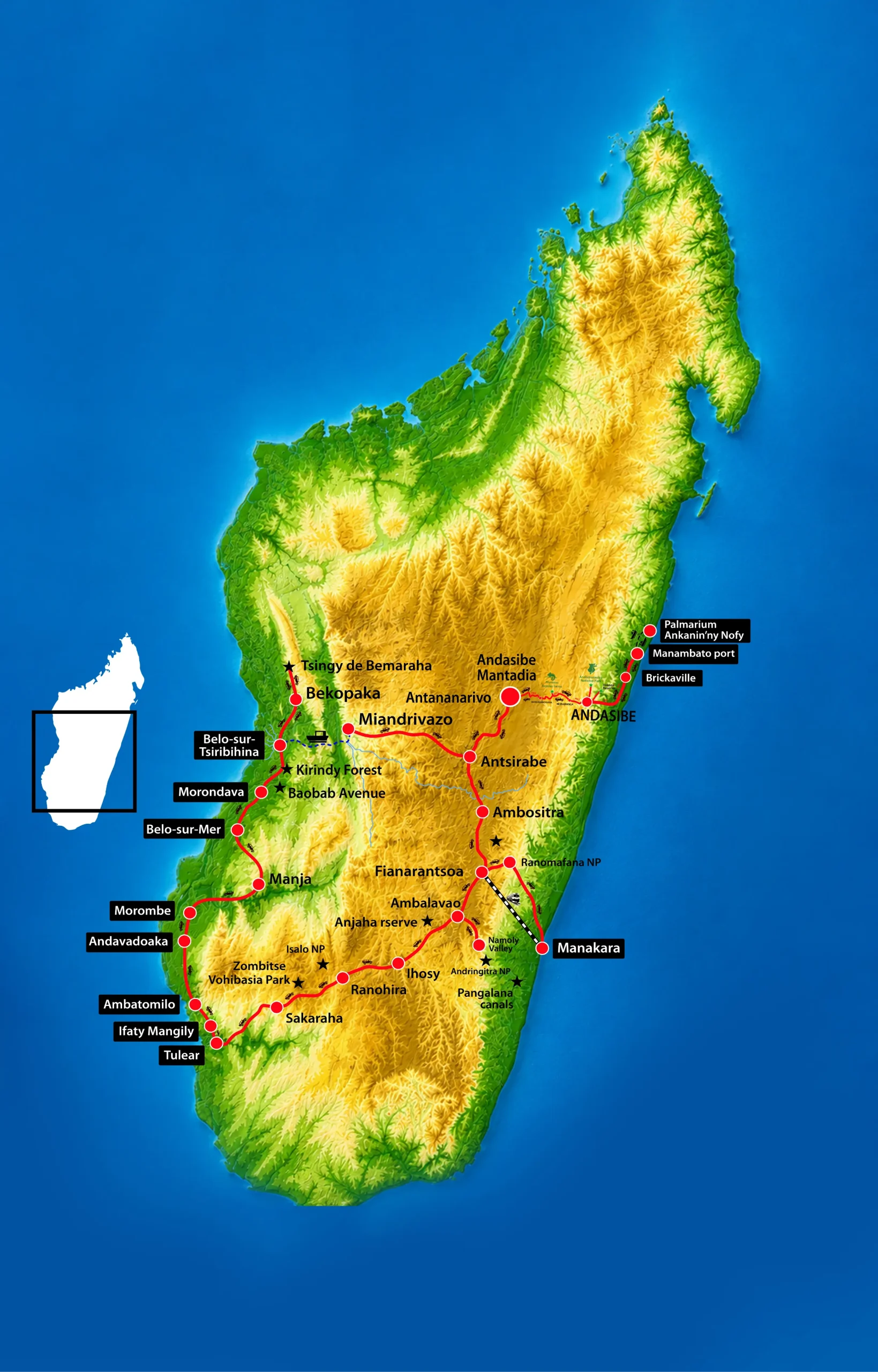
Ivato airport → Antananarivo → Antsirabe → Miandrivazo →Masiakapy → Tsiribihina river delta → Tsiribihina river →Nosinapela waterfall → Berevo → Belo sur Tsiribihina → Bekopaka → Big Tsingy → Gorge of Manambolo → Small Tsingy → Belo sur Tsiribihina → Kirindy forest → Baobabs Alley for sunset → Morondava → Belo sur Mer → Manja → Andavadoaka → Ambatomilo → Ifaty Mangily → Baobabs reserve → Tortu reserve →Tulear → Zombitsy vohibasia park → Isalo window → Ranohira → Isalo national park → Anjaha reserve → Ambalavao → Namoly → Andriapotsy campsite → Peak boby → Namoly → Ambalavao →Fianarantsoa → Manakara → Pangalana canal → Ranomafana →Ranomafana national park → Ambositra →Antananarivo →Peyrieras reptiles farms → Andasibe →Night walk at Andasibe → Analamazaotra national park → Ilot de lodge vakona → Andasibe →Manambato port → Palmarium Ankanin ny Nofy → First night walk at Palmarium → Diurnal visit at Palmarium →Visit village of Andranokoditra at Palmarium → Second nights walk at Palmarium → Palmarium port → Manambato port → Antananarivo → A short Tana city tour → Digue market → Ivato airport .
Antananarivo – Antsirabe
Antsirabe – Miandrivazo
Miandrivazo – MasiakapyMasiakapy – Tsiribihina delta
Belo sur Tsiribihina port – Bekopaka
Bekopaka – Big tsingy car parking – Bekopaka
Bekopaka – Small Tsingy car parking – Bekopaka
Bekopaka – Kirindy forest
Kirindy forest – Baobabs Alley – Morondava
Morondava – Belo sur Mer
Belo sur Mer – Manja
Manja – Andavadoaka
Andavadoaka – Ambatomilo
Ambatomilo – Ifaty Mangily
Ifaty Mangily – Tulear – Zombitsy vohibasia park – Isalo window – Ranohira
Ranohira – Isalo national park – Ranohira
Ranohira – Anjaha reserve – Ambalavao
Ambalavao – Fianarantsoa
Fianarantsoa – Manakara
Manakara – Pangalana canal port – Manakara – Ranomafana – Night walk – Ranomafana
Ranomafana – Ranomafana national park – Ranomafana
Ranomafana – Ambositra – Antsirabe
Antsirabe – Antananarivo – Peyrieras reptiles farms – Andasibe – Night walk – Andasibe
Andasibe – Analamazaotra national park – Ilot de lodge vakona – Andasibe
Andasibe – Manambato port
Manambato port – Antananarivo
Antananarivo (1 night) / Antsirabe (1 night) / Miandrivazo (1 night) / Tsiribihina river (1 night at the campsite) / Bekopaka (3 nights) / Kirindy forest (1 night) / Morondava (1 night) / Belo sur Mer (1 night) / Manja (1 night) / Andavadoaka (1 night) / Ambatomiloha (3 nights) / Ifaty (1 night) / Ranohira (2 nights) / Ambalavao (1 night) / Andringitra national park (1 night at the campsite) / Fianarantsoa (1 night) / Manakara (1 night) / Ranomafana (2 nights) / Antsirabe (1 night ) / Andasibe (2 nights) / Palmarium Ankanin ny Nofy (3 nights) / Antananarivo (1 night).
Antananarivo / Antsirabe / Miandrivazo / Bekopaka / Kirindy forest / Morondava / Belo sur Mer / Manja / Andavadoaka / Ambatomiloha / Ifaty / Ranohira / Ambalavao / Andringitra national park / Fianarantsoa / Manakara / Ranomafana / Antsirabe / Andasibe / Palmarium Ankanin ny Nofy / Antananarivo
Snorkeling at Nosimanjaboaky at Ambatomilo / Reniala baobab reserve at Ifaty Mangily / Turtle reserve at Ifaty Mangily / Zombitsy Vohibasia park / Isalo national park / Anjaha reserve / Night walk at Ranomafana / Ranomafana national park / Peyrieras reptiles farms at Marozevo / Night walk at Andasibe / Analamazaotra national park / Ilot de lodge Vakona / The first night walk at Ankanin ny Nofy Palmarium / Diurnal visit at Palmarium / Andranokoditra Village,s visit / The second nights walk at Palmarium Ankanin, ny Nofy / A short Tana city tour visit .
Full board on the Tsiribihina river / Formalities at the police office in Miandrivazo and Masiakapy / A motor barge and boatmen / Mineral water on the river and at the Tsingy visits / Camping equipment on the river / Entrance fee at the waterfall of Nosinapela / Local 4wd during 5 days / Entrance to the Tsingy of Bemaraha and a local guide / The ferry boats in Belo sur Tsiribihina and Bekopaka Andadoany / All facilities on the tour / An assistant guide during the tours / Communal taxes at Masiakapy: Gendarmes or Soldiers, Boarding fee / 1st diurnal visit at Kirindy forest / Night walk at Kirindy forest / Jumping rate visit / 2nd diurnal visits at Kirindy forest / Parking car at Baobabs Alley .
Road taxes The 4wd during 7 days (pick up and drop-off) A ferry boat on Bevoay river 10-Andringitra national park: Tickets and a local guide in Andringitra national Park / All camping equipment during the hike / Porters / Full board in Andringitra national park / The 4wd during 2 days / Mineral water during the hike 11-Excursion on Pangalana canal: Picnic lunch on Pangalana canal / A local boat and boatmen / A local guide and the boatmen . 12-Train from Fianarantsoa to Manakara: Train tickets / A local guide 13-Transfer by cars: Ivato airport → Antananarivo city / Antananarivo city → Andohalo Catedral → Digue market → Ivato airport.
| Travelers | Price |
|---|---|
| 1 Pax | € 8070 |
| 2 Pax | € 4670 per person sharing |
| 4 Pax | € 4520 per person sharing |
| 6 Pax | € 4370 per person sharing |
| 8 Pax | € 4220 per person sharing |
| 10 Pax | € 4070 per person sharing |
Ivato airport → Antananarivo city → Hotel (-,-,-) / (15 Km – 1 hour drive)
Upon your arrival at Ivato International Airport, you will be warmly welcomed and transferred to your hotel in the city center. After check-in, we will handle all necessary formalities and can assist you with exchanging your currency into the local currency.
Overnight at Chalet des Roses hotel, standard room
Antananarivo → Antsirabe → Hotel (B,-,-) / (170 Km – 7 hours drive)
We’ll drive from your hotel towards Antsirabe, passing through beautiful mountainous landscapes and lush rice paddies. Along the way, we’ll make stops for photos and admire the red laterite houses of the Imerina people. In Ambatolampy, we’ll see its renowned aluminum workshops and learn about the local transport, “taxi-brousses”. It’s also the repair center for taxi-brousses (the popular local transport).. Upon arrival in Antsirabe, also known as “The Malagasy Vichy” (Thermal baths)., We’ll explore the city, visit tailors and gemstone shops
Overnight at Flower hotel, standard room.
Antsirabe → Miandrivazo → Hotel (B,-,-) / (225 Km – 8hours drive)
After breakfast around 7 am, we’ll head towards Miandrivazo, which should take around 8 hours. As we drive, you’ll see some stunning scenery and pass through small towns and villages. We’ll stop at a local village for lunch to experience Malagasy cuisine and culture. In Malagasy, a restaurant is often called a “hotely,” which can also refer to a hotel or inn. It’s common for small rural restaurants to be attached to guesthouses or lodgings. In the late afternoon, we’ll arrive in Miandrivazo, check into our hotel, and rest for the night. Don’t forget to ask the hotel staff for help ordering your dinner.
Overnight at Soa Lia hotel, standard room
Miandrivazo → Masiakapy → Tsiribihina river delta →Tsiribihina river on motor boat → Nosinapela waterfall → Berevo → Camping (B,L,D) / (A full-day cruise)
After breakfast, transfer to Masiakapy by private car and transfer again by second cars to the start point of our Tsiribihina river tour. Here, we will start the calm water river journey on the majestic Tsiribihina river. You can sit back, relax and enjoy many beautiful landscapes and many kinds of wild animals like: Herons, Wild ducks, Parrots, Raptor birds, Kingfishers, Chameleons and Butterflies.
In the midday, we cross the massif of Bemaraha. It overflows with a fantastic landscape, deciduous forest with its lemurs and the marvelous sounds of birds.
In the afternoon, we will have a shower under the best waterfall of Madagascar: “Nosinapela” and its natural swimming-pool. After this nice waterfall, we keep cruising toward Berevo village where we will set up camp on a sand bank, build a fire and cook your dinner. Enjoy your meal, the sounds of the river and watch the sun go down. We sit around the campfire where songs can be sung in honor of the staff…:-)
Camping
Tsiribihina river → Belo sur Tsiribihina →Bekopaka → Hotel (B,L,-)/ (A half-day cruise and 100 Km – 5 hours drive)
We’ll spend a half-day on a motor barge, enjoying lunch on-board before arriving at the Belo sur Tsiribihina port. Our vehicles will be waiting for us there, and we’ll load our baggage and say “veloma” or goodbye to the boatmen. We’ll then hop into Malagasy sport-utility vehicles and begin the 4-5-hours drive on a rough road to Bekopaka. Along the way, we’ll cross the Manambolo River on a small ferry before reaching Bekopaka village. Once we arrive, you can check into your hotel and relax.
Overnight at Olympe de Bemaraha hotel, standard bungalow.
Bekopaka → Big tsingy (Andamozavaky circuit) → Bekopaka → Hotel (B,-,-) / (30 Km – 3 hours drive and 4-hour trail and hike)
Explore the intricate network of canyons and primary forest, marveling at the clusters of limestone sculpted by centuries of rainfall. This area is one of the most captivating sites in Madagascar and is home to the impressive Sifaka lemurs. After our hike, you can retire to your hotel for some well-deserved rest.
Overnight at Olympe de Bemaraha hotel, standard lodge bungalow.
Bekopaka → Gorge de Manambolo → Small Tsingy (Andadoany circuit) → Bekopaka → Hotel (B,-,-) / (3 Km – 20 minutes drive and 4- hour trail and hike)
Take a tranquil pirogue boat ride through the river gorge, where towering cliffs loom overhead with vertical walls carved by the flowing water. Immerse yourself in the impressive silence and serenity of the surroundings. Afterward, visit the small Tsingy for an unforgettable experience.
Overnight at Olympe de Bemaraha hotel, standard bungalow
Bekopaka → Belo sur Tsiribihina → Kirindy forest → The first diurnal visit → Night walk → Hotel (B,-,-) / (150 Km – 7 hours drive and 3.5 hours visits)
Visit to the Kirindy Forest Reserve, located 60 km north of Morondava. Kirindy forest is about 10,000 ha, it used to be managed by the Swiss, hence its nickname ‘Swiss forest’. This reserve is pursuing several goals: the preservation of several species of diurnal and nocturnal lemurs and the presence of animals like the Fosa and Giant jumping rat. It also protects the unique freshwater turtle of Madagascar. The reserve furthermore houses 45 species of birds and 32 species of reptiles.
Overnight at Kiridy Forest hotel , ecolodge Bungalow
Kirindy forest → The second Diurnal visits → Kirindy forest → Baobabs alley → Morondava → Hotel (B,-,-) / (60 Km – 4 hour drive and waiting sunset until 7 pm)
After breakfast, we return for a two-hour visit to Kirindy Forest, where you may spot sifaka lemurs, various bird species, and other wildlife, as well as admire the iconic baobab trees.
We then head back to the bungalow for a short rest. After lunch, at around 2:00 PM, we depart and arrive at the famous Avenue of the Baobabs at approximately 4:00 PM. Here, you will have plenty of time to take photos and enjoy the stunning scenery until sunset.
Afterward, we continue our journey and arrive in Morondava at around 8:00 PM. Upon arrival, you can relax in your room, followed by dinner and an overnight stay.
Overnight at Laguna Beach hotel, comfort room
Morondava → Belo sur Mer → Hotel (B,-,-) / ( 96 Km – 4 hours drive)
After breakfast, we depart at around 8:00 AM and head towards Belo sur Mer. The journey follows a secondary road, crossing several small rivers along the way. We arrive in Belo sur Mer around noon, check in at the hotel, and then enjoy lunch.
In the afternoon, you can relax at the hotel or take a walk around the charming town. Belo sur Mer is a beautiful small fishing village, well known for its traditional dhow construction. It is a wonderful seaside destination, offering crystal-clear waters and a peaceful atmosphere.
Overnight at Belo beach hotel, mid-range resort Bungalow.
Belo sur Mer → Manja → Hotel (B,-,-) / (105 Km – 6 hours drive)
After breakfast, we depart at around 7:00 AM and head towards Manja. The road is quite rough, crossing several small rivers and passing through rice fields along the way. We also travel through Kirindy Mitea National Park before leaving the coast and heading inland.
We arrive in the small farming town of Manja around noon, check in at the hotel, and enjoy lunch featuring zebu steak.
In the afternoon, you can relax at the hotel or take a walk around the village to experience the local way of life.
Overnight at Kanto hotel, mid-range room
Manja → Andavadoaka → Hotel (B,-,-)/ (197 Km – whole day drive)
After breakfast, we set off by 4×4 towards the charming town of Morombe, passing through a diverse and scenic landscape. Along the way, we cross the Mangoky River near the village of Bevoay. Baobab trees are widespread throughout this region of the island, adding to the unique beauty of the journey.
We then continue to Morombe, where lunch will be served.
After approximately 45 km, we reach the remarkable coastal site of Andavadoaka.
Overnight at OLO BE, resort bungalow
Andavadoaka → Ambatomiloha → Hotel (B,-,-)/ (50 Km – Half day drive)
Today, we travel by 4×4 along a beautiful coastal track, where the only traffic you are likely to encounter is traditional zebu carts. Along the way, we pass through an impressive forest of spiny baobab trees before arriving at the charming seaside village of Ambatomilo.
Overnight at Shangri-la Lodge , standard resort bungalow
Ambatomilo (B,-,-)
Today is a day at leisure. You can relax and enjoy the surroundings, take a walk along the beach, or choose from optional activities such as diving, snorkeling, or a canoe trip along the coast.
Overnight at Shangri-la Lodge, standard resort bungalow.
Ambatomilo (B,-,-)
Another resting day.
Overnight at Shangri-la Lodge, standard resort bungalow
Ambatomilo → Ifaty Mangily → Reniala baobabs → Turtle reserve → Ifaty → Hotel (B,-,-)/ (104 Km – Half day drive)
Ambatomiloha and Ifaty both offer stunning coastal views, and a stop for lunch at Ankasy Lodge is sure to be a delightful experience.
After lunch, we continue driving for two more hours to reach Mangily Ifaty. Here, you will visit the Baobab Reserve and the Turtle Reserve. The Baobab Reserve is home to some of the most magnificent baobab trees in the world, while the Turtle Reserve offers a unique opportunity to observe these fascinating creatures up close.
After your visits, we head to the hotel for check-in, where you can relax and unwind.
Enjoy your journey and the memorable experiences along the way!
Overnight at Vovotelo, comfort room with AC
Ifaty → Tulear → Zombitsy vohibasia park → Isalo window → Ranohira → Hotel (B,-,-) / (266 Km – whole day drive with stop visits)
After breakfast, we continue along the coastal route and arrive in Tulear, where we switch from our 4×4 vehicle to another car with a driver. Tulear is the largest city in southern Madagascar, often referred to as the “City of the Sun.”
We then continue along National Road RN7, passing through a striking landscape of thorny vegetation typical of the south. Along the way, we may also see the distinctive Mahafaly tombs, an important cultural feature of one of Madagascar’s ethnic groups.
Around midday, we make a short visit in the Zombitse-Vohibasia Reserve, where you may spot another species of lemurs as well as the impressive Adansonia Za baobabs.
We then continue our journey through Ilakaka, the famous sapphire town. In 1998, a zebu herder discovered sapphires here, and since then the area has become known for large-scale gemstone mining.
By late afternoon, we arrive in Ranohira, where we check in at the hotel and relax.
Overnight at Jardin du Roi hotel, comfort room with AC
Ranohira → Isalo national park → Ranohira → Hotel (B,-,-) / (20 Km – 1 hour drive, Half day trekking )
We drive to the Natural Swimming Pool area and park the vehicle before entering the park. The surrounding landscapes are breathtaking, shaped over time by wind and water erosion.
After a 3 km walk, we reach the Piscine Naturelle, a natural oasis where you will have the opportunity to swim and relax. We then continue our hike through the dry deciduous forest to the Namaza campsite, where a picnic lunch will be served.
In the afternoon, we visit the Cascade des Amoureux and enjoy swimming in the Blue and Black Pools before returning on foot to the campsite. From the Namaza parking area, we drive back to the hotel for relaxation.
Overnight at Jardin du Roi hotel, comfort room with AC
Ranohira → Anjaha reserve → Ambalavao →Hotel (B,-,-) / (224 km (139 miles) – 6 hours drive plus visits )
We continue our journey across the vast and open Horombe Plateau, home of the Bara people, who are well known for their zebu herding traditions. Along the way, we pass through the town of Ihosy and observe Ifandana Peak (1,025 m), also known as “The Bishop’s Cap” due to its distinctive shape.
We then continue for another 18 km before reaching the town of Ambalavao, followed by a visit to the beautiful Anja Community Reserve, a protected area rich in flora and fauna, including many ring-tailed lemurs.
Although the drive is quite long, it is very scenic, with opportunities for photo stops along the way. In the afternoon, we arrive at our hotel for check-in and relaxation.
Overnight at Tsianiparihy hotel, standard Bungalow
Ambalavao → Namoly valley → Andringitra national park → Hike → Andriapotsy campsite → Camping (B,L,D) / (45 Km – 3.5 hours drive plus hike)
Andringitra National Park is a true haven for nature lovers, offering a rich variety of flora and fauna to discover. The park features several hiking circuits of varying difficulty levels, allowing visitors to explore at their own pace.
After purchasing picnic supplies and hiking provisions, we drive to the Namoly Valley, the main entrance to the park. Upon arrival, we obtain the necessary permits and are joined by a local guide and porters.
We then begin a 4–5 hour hike from Namoly Valley (1,740 m) to the Andriampotsy Campsite (2,100 m). The trek involves an elevation gain of approximately 400 meters, and we will stop along the way for a picnic break to rest and enjoy the scenery.
Overnight at the campsite
Andriapotsy camp site → Peak Boby → Andriapotsy campsite → Namoly valley –→Ambalavao → Fianarantsoa → Hotel (B,L,-)/ (100 Km – 5 hours drive plus hike)
We will wake up early at around 3:00 AM to begin a thrilling adventure to the second-highest peak in Madagascar, Peak Boby. Standing at 2,658 meters, the ascent involves a 2-hour climb with a 400-meter positive elevation gain. From the summit, you will be rewarded with breathtaking panoramic views—an unforgettable moment to capture through photography.
After enjoying the scenery at the peak, we descend back to the Andriampotsy campsite, which takes approximately 2 hours with a 400-meter descent. A delicious breakfast will be served at the campsite before we continue our journey.
We then trek back from Andriampotsy to Namoly Valley, a 4-hour walk with another 400-meter descent. Upon arrival, we enjoy a picnic lunch before boarding our vehicle for a 3-hour drive to Ambalavao.
We continue onwards toward Fianarantsoa, a relatively short drive filled with interesting scenery along the way. Fianarantsoa is known for its rich history and strong connection to education, notably influenced by Queen Ranavalona’s establishment of schools in the region.
Overnight at Zomatel hotel, suite junior room
Fianarantsoa → Train → Manakara → Hotel (B,-,-)/ (100 Km – whole day trip by train )
Riding the passenger train from Fianarantsoa to Manakara is a one-of-a-kind experience that you’ll never forget. This is the only active passenger train in Madagascar, offering stunning views of cliffs, valleys, waterfalls, and the TANALA tribe’s way of life. It’s fascinating to see how locals utilize the train for the transportation of goods, such as bananas and coffee, to the big cities or for export. To embark on this adventure, we will enjoy an early morning breakfast and then drive to the Fianaratsoa train station. The train departs before 8 am and winds through the countryside until it reaches Manakara. The journey takes several hours, and we can expect to arrive in Manakara by 5 pm. Upon arrival in Manakara, we will transfer to our hotel and check-in. This will be an excellent opportunity to relax and recharge after a long journey and to prepare for the exciting adventures that lie ahead.
Overnight at Partenay hotel, standard room
Manakara → Excursion on the Pangalane canals → Manakara → Ranomafana → Night walk → Ranomafana → Hotel (B,L,-)/ (181 Km – 4 hours drive)
Exploring the Pangalana Canal on a cruise is both adventurous and captivating. Along the riverbanks, you’ll encounter the unique way of life of the Antaimoro tribe, who rely on fishing and hunting for their daily survival. Throughout the journey, a local guide shares insights into their traditions, culture, and the surrounding environment, often accompanied by light entertainment from the guide and their team.
The excursion continues with a walking tour of a nearby village, where the guide explains community initiatives that support local residents. Visitors also have the opportunity to purchase fresh vanilla beans directly from villagers, offering a meaningful way to contribute to the local economy.
After the walk, you can enjoy a delicious lunch in the shade of the trees, featuring freshly caught fish and local flavors, an authentic and relaxing moment in nature.
In the afternoon, the journey continues toward Ranomafana, with arrival expected around 4:00–5:00 PM, followed by hotel check-in. Later, at around 6:00 PM, you’ll meet a local guide for a nocturnal wildlife excursion. This is a chance to spot fascinating species such as mouse lemurs, frogs, and chameleons in their natural habitat.
By approximately 7:30 PM, you’ll return to the hotel for dinner before settling in for a well-deserved rest after a full and enriching day of exploration.
Overnight at Thermal hotel, comfort room
Ranomafana → Ranomafana national park → Ranomafana →Hotel (B,-,-)
After breakfast, we drive to the entrance of Ranomafana National Park to begin a daytime visit lasting approximately 4 to 5 hours. Accompanied by a local guide and an experienced spotter, you’ll explore this beautiful humid tropical rainforest, renowned for its rich biodiversity.
During the walk, you may encounter a variety of wildlife, including the Red-bellied Lemur, the Greater Bamboo Lemur, the Golden Bamboo Lemur, and Milne-Edwards’ Sifaka. The park is also home to numerous bird species and striking reptiles such as the leaf-tailed gecko (Uroplatus phantasticus). The Golden Bamboo Lemur (Hapalemur aureus) remains the park’s main highlight, known for its rarity and unique adaptation to feeding on bamboo.
In the afternoon, we return to the hotel, where you can unwind and enjoy some well-deserved relaxation. You’ll have the option to spend time at the thermal pool, either at the public springs or within the hotel itself.
The rest of the day is free for you to relax at your own pace before dinner at the hotel.
Overnight at Thermal hotel, comfort room
Ranomafana → Ambositra → Antsirabe → Hotel (B,-,-) / (227 km – 5.5 hours drive)
After breakfast, we head north while enjoying the beautiful Betsileo landscapes, characterized by terraced rice fields.
Our main stop is in Ambositra for lunch, followed by a short city tour to discover the region’s typical Malagasy craftsmanship, including marquetry, weaving, and especially wood carving.
We then continue to Antsirabe, a highland city located in the center of Madagascar and the capital of the Vakinankaratra region. It is the third largest city in the country.
Arrival in Antsirabe is scheduled for the end of the afternoon.
Overnight at Arotel hotel, suite junior room
Antsirabe → Antananarivo → Peyrieras reserve →Andasibe → Night walk → Hotel (B,-,-) / (309 Km – whole day drive with visit)
We take National Route 07 again and arrive in Antananarivo from the south.
After a short turnaround, we continue east towards Andasibe.
Along the way, we enjoy the beautiful and varied landscapes of the highlands, with rice fields, ravinala trees, and oil palm plantations.
We make a short stop at Marozevo (Peyrieras Reserve) to visit a breeding farm of reptiles and small mammals.
Upon arrival in Andasibe, we check in at the hotel.
Later in the afternoon , we drive to the entrance of Analamazaotra National Park for an interesting night walk, where we can discover nocturnal lemurs, chameleons, and frogs.
After the visit, we return to the hotel.
Overnight at Feon ny Ala hotel, standard lodge bungalow
Andasibe → Analamazaotra national park → Ilot de lodge vakona → Hotel(B,-,-)
Enjoy a morning visit to Analamazaotra National Park for a guided walk of approximately 2 to 4 hours. This visit offers the chance to spot the Indri indri, along with various other species of lemurs, as well as birds, orchids, and insects.
Return to the hotel for lunch.
At around 2:00 p.m., depart for Vakona’s reserve to visit the Lemur Island. Here, you will encounter black-and-white ruffed lemurs, Brown lemurs, Eastern Grey Bamboo lemur and other species.
We’ll drive to the crocodile farms at the Vakona Hotel, where you’ll discover the Nile crocodile (Crocodylus niloticus).
These imposing reptiles are the largest crocodiles in Africa and dominate the rivers of sub-Saharan Africa and Madagascar. Adult males can reach up to 5.5 meters in length and weigh as much as 750 kilograms.
Nile crocodiles inhabit freshwater lakes, rivers, and swamps, then are also well adapted to brackish waters throughout these regions.
After completing the visits above, return to the hotel for some well-deserved relaxation.
Overnight at Feon ny Ala hotel, standard lodge bungalow
Andasibe → Manambato port → Pangalana Canal → Palmarium Ankanin’ny Nofy → First night walk → Palmarium Ankanin ny Nofy → Hotel (B,-,-) / (140 Km – 4 hours drive and 1.30 hours on motor boat )
After breakfast, we rejoin National Road N02, the most congested and winding road in Madagascar. Despite this, it is a beautiful drive. We travel toward Brickaville Village , a large district we pass through before turning off toward Manambato.
The journey covers approximately 140 km and takes 4 to 6 hours, depending on road conditions, which are mixed, some sections are in good condition, while others are quite rough. We make a short stop at Antsampanan,ny Brickaville, a perfect place for fruit lovers, with a wide variety of fresh fruits available to buy and enjoy.
As we continue, we enter the heart of the Betsimisaraka region, an area known for its hot, rainy climate and once-dense rainforest. Sadly, much of the original forest has disappeared due to human activity, leaving behind large areas of barren land.
We arrive at Manambato around noon, where we stop for a light lunch before boarding a boat to Palmarium Ankanin’ny Nofy.
At 2:00 pm, we depart by speedboat from the Manambato hotel, crossing Lake Rasoabe and then Lake Rasoamasay, one of the largest lakes in the Betsimisaraka region. We continue along the Pangalanes Canal and across Lake Ampitabe, considered the most scenic part of the route, with lush green forests and charming villages lining the banks. This speedboat journey takes approximately 1.5 hours.
Upon arrival at the Palmarium Hotel, the staff provides an orientation, explaining the facilities, lighting system, and the nocturnal visit scheduled for around 5:00–6:00 pm, and confirms our dinner preferences for the evening.
At around 5:30 pm, we set out again by speedboat to Nosin, Akoho, where we have the rare opportunity to observe one of the world’s most unusual and endangered lemurs: “the Aye-aye” (Daubentonia madagascariensis) is a long-fingered lemur, it is the world’s largest nocturnal primate, It is currently classified as Endangered by the IUCN / The genus Daubentonia was named after the French naturalist Louis-Jean-Marie Daubenton by his student / The French naturalist Pierre Sonnerat was the first to use the vernacular name “Aye-aye” in 1782 when he described and illustrated the lemur, though it was also called the “long-fingered lemur” by English zoologist George Shaw in 1800
This is a special moment, allowing time to stop and take photographs of this extraordinary species.
The visit lasts approximately one hour and is not always guaranteed, as sightings depend on conditions and local guide availability. We then return by speedboat to the hotel.
Overnight at Palmarium hotel, standard lodge bungalow
Palmarium Ankanin ny Nofy → Palmarium Reserve → Andranokoditra Village → The second nights walk → Palmarium → Hotel (B,-,-)
Starting at 8:00 a.m., the tour begins with a hotel guide who introduces the diverse plant life surrounding the hotel and the Palmarium Forest. The highlight of the visit is the opportunity to observe a wide variety of lemurs, including the red-bellied lemur (Eulemur rubriventer), one of the most captivating primates found in Madagascar’s lush rainforests. Known for its striking facial markings, rich reddish-brown fur, and elusive behavior, this species is a favorite among wildlife enthusiasts and eco-tourists.
We then continue a short distance on foot and arrive at the edge of Lake Ampitabe, where we observe pitcher plants known as Nepenthes madagascariensis. There are two species of Nepenthes found in Madagascar (Nepenthes madagascariensis and Nepenthes Masoalaensis . These carnivorous plants have pouch-shaped traps that emit a sweet scent to attract mosquitoes and other small animals. Once the prey enters the pouch, it becomes trapped by a sticky surface and slippery walls, making escape impossible, and is eventually digested by the plant.
Just a short distance away, a speedboat awaits us on the shores of Lake Ampitabe. We board the boat and go to Andranokoditra Village, where our guide explains the local environment and introduces us to the community, whose livelihood depends on both marine and freshwater fishing. We then take some time to explore the Indian Ocean side of the river, a moment that invites reflection on the beauty and generosity of nature.
Afterward, we return to the village, where the guide shares insights into the customs, traditions, and daily life of the Betsimisarana tribe. The visit concludes with a stop at a local shop selling essential oils, before returning to the Palmarium Hotel for lunch.
The afternoon is set aside for rest and relaxation at the hotel.
At 5:30 p.m., it is time for our second nocturnal visit, the main objective being to discover the chameleon Brookesia nofy, a rare and recently described species that is usually seen only when alone. During this night walk, we also encounter several other animal species. The visit lasts approximately 1.5 hours, after which we slowly return to the hotel for dinner and an overnight stay. Enjoy your final night at the Palmarium Hotel.
Overnight at Palmarium hotel, standard lodge bungalow
Stay at Palmarium Ankanin ny Nofy → Hotel (B,-,-)
Chill out.
Overnight at Palmarium hotel, standard lodge bungalow.
Palmarium Ankanin ny Nofy → Palmarium port → Manambato port → Antananarivo → Hotel (B,-,-)/ (280 Km – whole day drive)
We will need to wake up early, as we depart early. Breakfast will be served from 5:30 a.m.
At 6:30 a.m., we will take a speedboat to Manambato port, arriving at around 7:45 a.m.
From there, there will be no visits planned; we will continue our journey by car.
We will have lunch in Andasibe at a local restaurant and arrive in Antananarivo at around 5:00 p.m.
Enjoy your last night in Antananarivo.
Overnight at Samsara hotel, suite room
Antananarivo → Upper town in Tana → Digeu market → Ivato airport → Flying out (B,-,-)/ (15 Km – 1 hour drive)
Prior to your transfer to Ivato International Airport in Antananarivo, we can offer you a complimentary city tour, subject to your available time. This may include a visit to the Upper Town of Antananarivo, followed by some shopping along La Route Digues, before heading to the airport.
Prior to your transfer to Ivato International Airport in Antananarivo, we can provide you with a complimentary tour of the city, provided you have the time. This could involve visiting the upper quarter of Tana, followed by some shopping at “La Route Digue”, before arriving at the airport.